Note: these posts are copied over from the ‘mathbucket’ section of my old tumblr blog and I haven’t put much effort into this, so there is likely to be context or formatting missing.
Actually programming is doing one good thing for me, by forcing me to engage with a more algorithmic/symbolic mode of thinking that I’ve kind of ignored as much as I can in the last few years. I find it frustrating a lot of the time, partly because it’s not particularly how my brain works but also because normally the structural component is the the main thing, there is no there there. (Or what’s there is incredibly intrinsically uninteresting to me, like parsing some file or whatever).
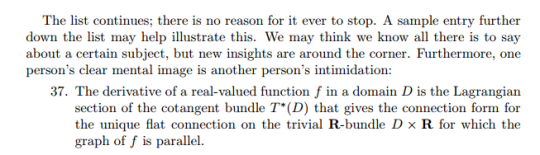
At the other end of the spectrum is differential geometry, which I have this kind of doomed love for despite not being especially good at it. I love it because the questions are so tangible – ‘how does this surface curve?’ – and the particular methods you use are correspondingly less important if you have the right intuition for the tangible problem. I mean they are still important, there are definitely more and less elegant ways of doing things, but structure is at least somewhat downplayed compared with the actual thing you want to know about, which is how this surface curves.
I mean I found a differential geometry book by Serge Lang in the library once, I don’t think I dreamt it, and it was a proper Bourbaki-style algebraist’s version of differential geometry. No pictures and everything was done with some kind of quadratic form iirc. After that I was kind of convinced that you can build differential geometry out of anything you have to hand.
Note: these posts are copied over from the ‘mathbucket’ section of my old tumblr blog and I haven’t put much effort into this, so there is likely to be context or formatting missing.
I finally got nerd-sniped by the Arbital thing, so here are some rambly thoughts.
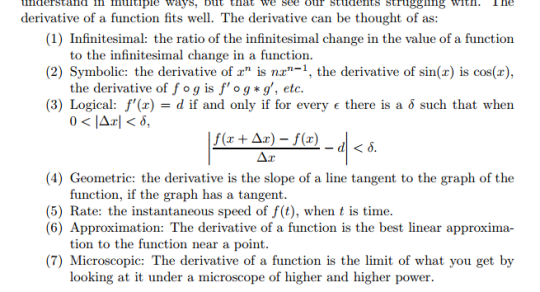
I’m definitely intrigued by the idea, because there are a lot of topics in maths that can be understood at very different levels. It’s true that there is often a level of understanding below which you have very little hope (e.g. @nostalgebraist‘s example of reading the integration by parts page without calculus). But often there are many tiers of understanding above the first. E.g. Thurston talking about different concepts of the derivative:
So I can see some potential here. However I’m not at all taken with the current implementation. The biggest dud for me is the clunky, prescriptive questionnaire interface over the top of it. I’m normally pretty good at identifying whether I can follow an explanation once I can actually see it, the main advantage I can see to the site is having many such explanations in the same place for easy access. I don’t want to be tediously clicking through branching pathways, like some Choose Your Own Adventure book where every adventure is just Bayes’s theorem again.
To my mind that part of Arbital’s just plain bad, but another aspect of the site that I don’t like may improve with time. At the moment it’s heavily curated, giving it a very homogeneous textbook feel. It sounds like the idea is to allow users with enough karma to contribute themselves, and then it may become more diverse.
I think the thing I would like is more *styles* of explanation rather than particularly different *levels*. For example, here’s the earlier part of Thurston’s list [this is such a wonderful paper, if for any misguided reason you are reading all this rubbish you should just go and read that instead :)]:
These are very different ways of thinking of a derivative, but I wouldn’t say that they are at different levels. I think different ones will appeal to different people, and your ideal starting point will vary depending on that. (Eventually you need to learn the others, of course, but initial motivation is important. For me (1) and (4) feel the most natural, and motivate me to learn the incredibly necessary (2), and even to deal with the tedium of (3)). I guess my ideal maths-explanation site would have a variety of explanations at each level.
[At which point, is it even worth trying to collect all this disparate stuff on one site? I honestly don’t know.]
My final bloody obvious objection is that politically they should definitely not have gone for Bayes’s theorem as a nice uncontroversial starting example instead of basically any other topic in mathematics, but, well, Yudkowsky and doing the politically sensible thing rarely go together.
Still, after all that grumbling I do appreciate any attempts at providing better explanations for mathematical concepts online. I find this stuff really interesting for some reason, and the idea I personally like to think about is an approach I call ‘examples first’, after thesetwo blog posts by Timothy Gowers. (The second one has an absolutely epic comment thread – reading that and following the links has taught me more maths than any single course I ever took at university.)
I always like to learn by following concrete worked examples. This may just be a personal preference, but it sounds from the blog post that it’s pretty common. In my case, out of the Arbital explanations the one I’d personally choose was the beginner-level one (so much for that questionnaire). I would always rather learn by doing problems about socks in a drawer than read an explanation in terms of some abstract variables A and B. If I’m learning maths from a textbook I always start by looking at the pictures and reading any waffly chunks of text, then look at the examples and exercises. I only grudgingly read the theory bit when I’m really stuck.
I guess what I would like is something like a repository of worked examples, where you search for a topic and then get a bunch of problems to try. Wikipedia generally ends up with a formalism-heavy approach, whereas I would always prefer to look at some specific function, or a matrix with actual numbers in it or something.
Note: these posts are copied over from the ‘mathbucket’ section of my old tumblr blog and I haven’t put much effort into this, so there is likely to be context or formatting missing.
The Cognitive Reflection Test came up in the SSC Superforecasters review. I’ve seen it a couple of times before, and it always interests me:
A bat and a ball cost $1.10 in total. The bat costs $1.00 more than the ball. How much does the ball cost?
If it takes 5 machines 5 minutes to make 5 widgets, how long would it take 100 machines to make 100 widgets?
In a lake, there is a patch of lily pads. Every day, the patch doubles in size. If it takes 48 days for the patch to cover the entire lake, how long would it take for the patch to cover half of the lake?
I always have the same reaction, and I don’t know if it’s common or I’m just the lone idiot with this problem. The ‘obvious wrong answers’ for 2. and 3. are completely unappealing to me (I had to look up 3. to check what the obvious answer was supposed to be). Obviously the machine-widget ratio hasn’t changed, and obviously exponential growth works like exponential growth.
When I see 1., however, I always think ‘oh it’s that bastard bat and ball question again, I know the correct answer but cannot see it’. And I have to stare at it for a minute or so to work it out, slowed down dramatically by the fact that Obvious Wrong Answer is jumping up and down trying to distract me.
I did a maths degree. I have a physics phd. This is not a hard question. Why does this happen?
I know I have a very intuition-heavy style of learning and doing maths. For the second two I have very strong cached intuitions that they map to, whereas I’m really lacking that for the first one for some reason. I mean, I can visualise a line 110 units long, and move another 100-unit line along it until there’s equal space at each end, but it’s not some natural thought for me.
Now, apparently:
The CRT was designed to assess a specific cognitive ability. It assesses individuals’ ability to suppress an intuitive and spontaneous (“system 1”) wrong answer in favor of a reflective and deliberative (“system 2”) right answer.
Yeah so that definitely isn’t getting tested for me. My System 2 hates maths and has no intention of putting in any effort on this test, but luckily System 1 has internalised the ‘intuitive and spontaneous’ answer for two of the questions for me. I will fail the first question unless my equally strong ‘the answer can’t be that obvious’ intuition fires, but that one makes me seriously worried about my answer to 3. as well.
My inability to internalise the bat and ball thing might be a quirk of my brain, but I’m sceptical of this test in general. It’s extremely vulnerable to having the right cached ideas.
Note: these posts are copied over from the ‘mathbucket’ section of my old tumblr blog and I haven’t put much effort into this, so there is likely to be context or formatting missing.
I thought it would be just duds from the back catalogue but they’ve put up loads of well-known texts at the undergrad and graduate level – particularly good for maths but some of the physics ones are also worth a look.
… and now for a pointless rant.
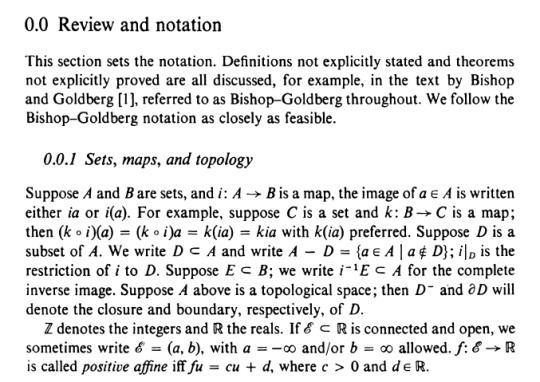
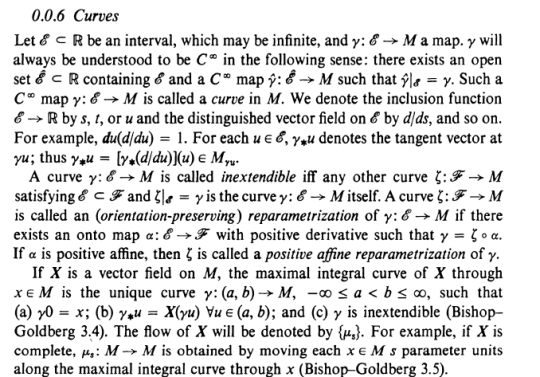
Why do so many maths textbooks insist on having this fucking boring introductory chapter that tells you a million preliminaries in incredibly terse prose? More symbols than words if you can possibly manage it? Like this:
I’m using Sachs and Wu’s General Relativity for Mathematicians as an example as that is the pdf I have open at the moment, but it’s not unusually bad, I could use anything really. And judging from the Preface this book is actually going to be pretty opinionated, with a distinctive writing style:
Many people believe that current physics and mathematics are, on balance, contributing usefully to the survival of mankind in a state of dignity. We disagree. But should humans survive, gazing at stars on a clear night will remain one of the things that make existence nontrivial.
That suggests a book that could be fun to read. Then it’s straight into exciting pages like this:
Who wants to read this stuff when they’ve just picked up a new book? It’s incredibly boring and does nothing to help me decide whether I’ll get anything out of the rest of the book. Why not, say, a basic example that illustrates something of what they want to cover? Or something interesting about the history of the subject? Or just a general overview of what’s coming up?
I’m sure there’s a reason I’m not getting, there usually is.
Do they want it to be self-contained? Well it’s still not self-contained, are they planning to teach me to count as well? It’s not the only book in the world anyway, surely I could just look at another book?
Do they want fix notation? That sounds a lot more reasonable, but surely they could just introduce the concepts in the context that they’re going to be used so that you actually remember them, with maybe a glossary of notation at the end?
Note: these posts are copied over from the ‘mathbucket’ section of my old tumblr blog and I haven’t put much effort into this, so there is likely to be context or formatting missing.
So yesterday I read about DragonBox, a game for learning algebra. I haven’t played it myself yet, just seen some videos, but it looks like you learn the rules by manipulating a bunch of pictures on a touch screen, and only later see the usual symbols and numbers.
Anyway I sent it to my sister, and it sounds like my 7-year-old nephew was happily playing it most of the evening. So that’s nice.
I read about it on Hacker News, and today there are a load of comments there probably duplicating a lot of the content of this one. I can’t be bothered to read them all right now, I’m in a writing mood more than a reading mood.
What interests me about this game is its complete focus on teaching the algorithmic component of algebra – cancelling factors, ‘throwing things over the equals sign’, multiplying both sides, whatever. Algebra as game mechanics. And that’s likely to be a good thing, as games are generally somewhat more fun than algebra classes. Learning the rules by playing around and seeing what happens is likely to be more successful than being told explicitly what the rules are, and being afraid to experiment too much in case you ‘get it wrong’.
Of course, the downside is that it’s completely divorced from a conceptual understanding of what you’re doing, and how it relates to the maths you already know. I’ve always been kind of annoyed at how late algebra is taught in schools, and how its separated so distinctly from arithmetic. I feel like a good start on the way to algebra is made right at the beginning of school, where you get those worksheets with the boxes to fill in:
1 + 3 = [ ]
2 + 4 = [ ]
and then for a bit of variety you might get
2 + [ ] = 5
later in the sheet. No big deal. Then somehow later in school the first two examples become ‘arithmetic’ and the third is some abstruse topic called ‘algebra’.
I feel like if it was introduced alongside arithmetic it might be easier to take in. E.g. when you first learn multiplication:
2 * 3 = [ ]
then why not also learn
2 * [ ] = 6 ?
It seems unfair to save all this stuff up for a few years and then intimidate you with the likes of
2 * [ ] + 3 = 7,
under the threatening new title of ‘algebra’, along with an array of confusing new algorithmic techniques for ‘solving’ an equation.
I’m not trying to criticise DragonBox. I think it’s a great idea. I guess what I’m wondering is what DragonBox’s twin looks like. The game that teaches conceptual understanding of algebra divorced from algorithmic understanding, with the same emphasis on playing around and not worrying too much about whether you’re doing the right thing. E.g. in the equation above you could just try some numbers and find that 2 works, or notice that 4 + 3 is 7 and work backwards, or anything else that helps. It would be nice to be able to use a bunch of examples like these to work towards finding a general algorithm for solving the equation, but one you’re using because it makes intuitive sense to you rather than because some teacher or some game told you to do it.
Note: these posts are copied over from the ‘mathbucket’ section of my old tumblr blog and I haven’t put much effort into this, so there is likely to be context or formatting missing.
Currently flicking through Seymour Papert’s brilliant ‘Mindstorms: Children, Computers and Powerful Ideas’. I’ve read it before but the whole book is popping with insights and I should probably do this many more times. Plus maybe this time it’ll actually teach me how to juggle too?
In the epilogue on mathematical thinking, he discusses his experiences getting people “with little mathematical knowledge” (enough to rearrange an equation, though) to work towards a proof that the square root of 2 is irrational. In the process, he gives two standard proofs, the second of which I’d never seen before:
Of these I shall contrast two which differ along a dimension one might call ‘gestalt versus atomistic’ or ‘aha-single-flash-insight versus step-by-step reasoning’.
They both start with the usual proof by contradiction: let sqrt(2)= p/q, a fraction expressed in its lowest terms. This is then rearranged to get
p^2 = 2 q^2,
and then you can go down the route of “well p must be even, so p=2r, so q^2=2r^2 WHY IS q EVEN TOO WHEN WE CANCELLED THE TWOS AT THE START?” Which is pretty compelling stuff.
But I really like the second proof, what he calls the ‘flash’ version:
Think of p as a product of its prime factors, e.g. 6=23. Then p^2 will have an even number of each prime factor, e.g. 36=2233. But then our equation p^2=2q^2 is saying that an even set of prime factors equals another even set multiplied by a 2 on its own, which makes no sense at all. Done.
Papert makes the point that if you have the right idea (decomposition into prime factors) ‘pre-loaded’ into your head, the equation is directly seen as absurd just by looking at it. In fact it now surprises me that it didn’t look wrong before! The first, more algorithmic proof gets you there, but without the insight flash.
Anyway, this is a lot of set-up just to say that reading this made me understand more clearly that that dopamine hit of insight is a large part of what I’m attracted to maths for. For me, much of the purpose of studying maths is to pre-load a pile of the necessary structure into my head to enable these insights to occur. Differential geometry is great for this, and this is probably why I like learning it so much! In the process I’m willing to put up with a load of chains of logic (which I am annoyingly poor at) but I’m always really hoping that they will be the means to an aha-single-flash insight.
OK time to go practice juggling (= ‘throwing all the balls on the floor’) again.
Note: these posts are copied over from the ‘mathbucket’ section of my old tumblr blog and I haven’t put much effort into this, so there is likely to be context or formatting missing.
This is great, and something I thought was missing from the SSC discussion (pity I’m too slow to ever get round to commenting). I only really got a tumblr to read some stuff, but I am fascinated by this topic so here is some related crap…
I think there’s a lot to this ‘different ways of understanding maths’ idea, sometimes it seems that you can pretty much give a mathematician a pen and they will start writing an essay on two types of mathematician. The clusters seem to be roughly ‘algebra/problem-solving/analysis/logic/precision’ vs. geometry/theorising/synthesis/intuition/hand-waving’ but there is plenty of variation.
I keep meaning to collect together a set of all of these I can find, so this has motivated me to make a first attempt:
“It is impossible to study the works of the great mathematicians, or even those of the lesser, without noticing and distinguishing two opposite tendencies, or rather two entirely different kinds of minds. The one sort are above all preoccupied with logic; to read their works, one is tempted to believe they have advanced only step by step, after the manner of a Vauban who pushes on his trenches against the place besieged, leaving nothing to chance.
The other sort are guided by intuition and at the first stroke make quick but sometimes precarious conquests, like bold cavalrymen of the advance guard.”
Gian-Carlo Rota made a division into ‘problem solvers and theorizers’ (in ‘Indiscrete Thoughts’, excerpt here)
Timothy Gowers makes a very similar division in his ‘Two Cultures of Mathematics’ (discussion and link to pdf here)
Freeman Dyson calls his groups ‘Birds and Frogs’ (this one’s more physics-focussed)
Vladimir Arnold turns the whole thing into a massive ideological war in his wonderful rant ‘On Teaching Mathematics’
Broadly speaking I want to suggest that geometry is that part of mathematics in which visual thought is dominant whereas algebra is that part in which sequential thought is dominant. This dichotomy is perhaps better conveyed by the words “insight” versus “rigour” and both play an essential role in real mathematical problems.
There’s also his famous quote:
Algebra is the offer made by the devil to the mathematician. The devil says: `I will give you this powerful machine, it will answer any question you like. All you need to do is give me your soul: give up geometry and you will have this marvellous machine.’
Finally, I think something similar is at the heart of William Thurston’s debate with Jaffe and Quinn over the necessity of rigour in mathematics – see Thurston’s ‘On proof and progress in mathematics’. There is also a wonderful list of ways of understanding the concept of a derivative in Section 2.
OK hopefully I know how to write a post now! Hope this is interesting to someone.
 drossbucket